Over the last couple of months our SMASH-HCM partners have been attending various conferences, where they have been presenting work from our project. Today we want to highlight two researchers from the department of computer science at the Oxford University.
Best presentation award at DigiTwin 2026
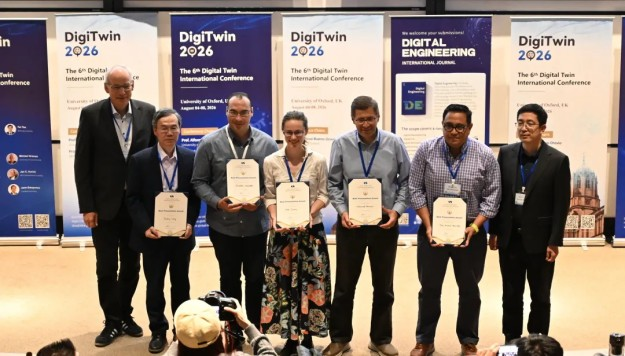
In August, Abdallah Hasaballa attended the 6th Digital Twin International Conference which was held at the University of Oxford. Abdallah’s presentation “A Cardiac Digital Twin of Hypertrophic Cardiomyopathy: From Disease Progression to Precision Therapy” was one of 5 presentations that won the best presentation award.
His presentation showcased a human cardiac digital twin designed to connect what happens at different scales, from changes in cell behaviour to the pumping function of the whole heart. Using this framework, we explored how the disease develops over time, showing how an initially overactive heart can gradually progress towards impaired filling and weaker overall performance. We also used the model to study the effects of mavacamten, a treatment that reduces excessive contraction. Our results show how cardiac digital twins can be used not only to represent anatomy, but also to explain disease mechanisms, test therapies, and support more personalised treatment strategies.
Rosanna Degani Young Investigator Award at Computing in Cardiology 2026
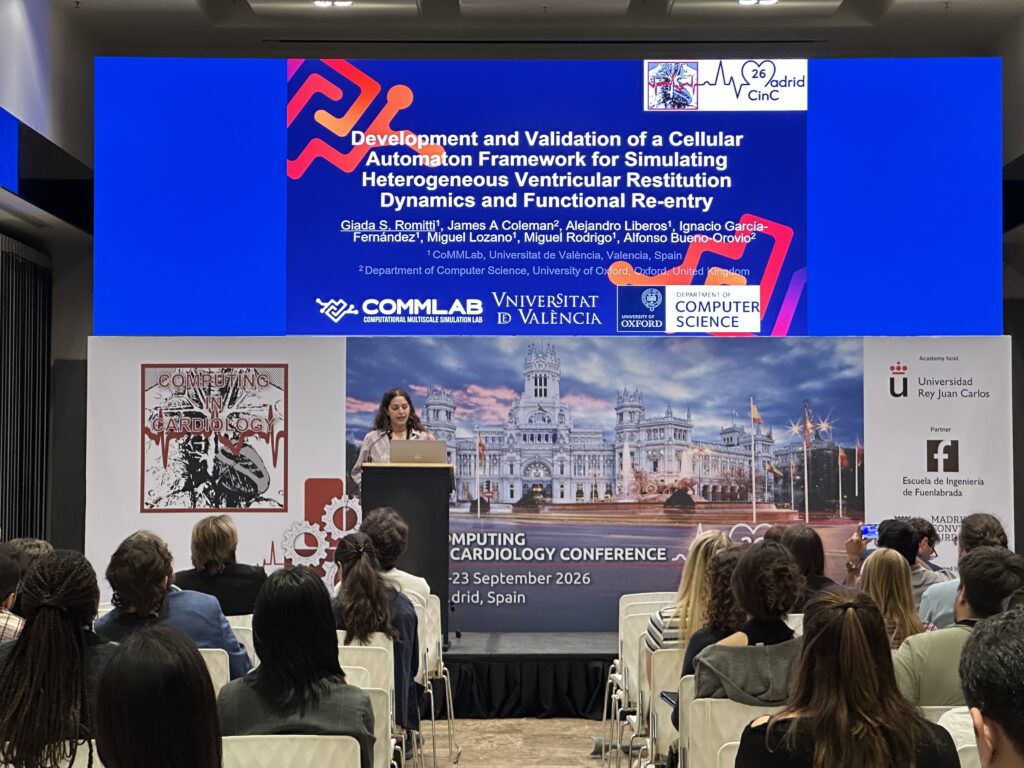
In September, Giada Romitti received the Semi-Finalist Award of the Rosanna Degani Young Investigators’ Award at Computing in Cardiology for her paper on “Development and Validation of a Cellular Automaton Framework for Simulating Heterogeneous Ventricular Restitution Dynamics and Functional Re-entry”.
Her paper presents a new computational framework based on Cellular Automata (CA) that makes cardiac simulations ~75 times faster while maintaining high accuracy. This work stems from a collaboration with the CoMMLab research group from the University of Valencia (link them). Crucially, unlike traditional CA models that are usually limited to anatomical re-entries around fixed scars, their approach models functional re-entries driven purely by tissue heterogeneity. Additionally, they incorporated for the first time a population-of-models approach within a CA framework to capture electrophysiological variability, using hypertrophic cardiomyopathy as a validation model for scalable arrhythmia risk assessment.
Winning image and overall competition winner in the ARCHER2 Image Competition 2026
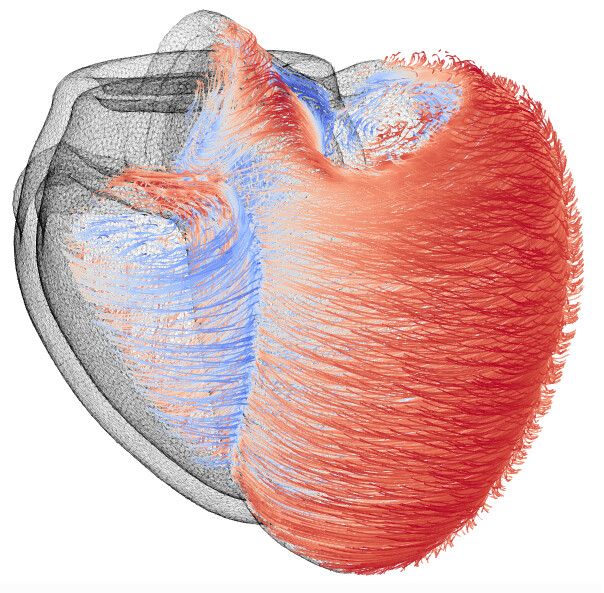
In early October Abdallah’s entry in the ARCHER2 Image Competition 2026 was selected as the winning image. His image of a “Blueprint of a Beat: The Heart’s Hidden Fibre Architecture” shows the hidden structure that allows the heart to beat efficiently. This image of a healthy heart depicts two halves of the heart, one displays the three dimensional geometry of the ventricles and the other half shows the orientation of the cardiac muscle fibres, which are arranged in a highly organised pattern. The fibres in blue are at +60 degrees angle at the inner surface of the heart wall, while the fibres coloured in red are at -60 degrees angle on the outer surface. The change in fibre direction is crucial to how the heart contracts and twists when pumping blood. The large scale computer simulations on ARCHER2 allow us to visualise this architecture in detail. This can then be used to further understanding of the heart’s function.